Programming, Topic: Procedural Content

Recent posts (Page 9 of 10)

Backtracking Worm Coral

Backtracking Worm Coral

Let’s take yesterday’s Worm Coral and turn it up to 11!

Now we have:

  • Whenever a worm gets stuck, it will ‘backtrack’: it will instead expand from the previous position recursively

That means that the initial 10 worms should always be able to fill the entire world! Even if one closes off an area, that one can eventually fill it up:
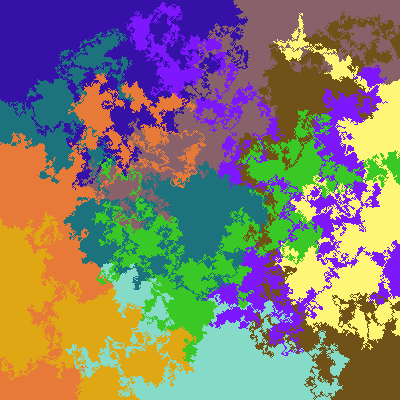
I like how occasionally you get one spindly bit (usually early in the run) that another goes through. It reminds me of Blokus It does take a while.

In addition, I wanted to play a bit with simulationism:

  • Worms can potentially changeColor each frame
  • Every framesPerGeneration check if each worm dies deathChance or spawns a child worm (spawnChance)
  • If a worm dies, it is removed from the simulation
  • If a worm spawns, it creates a new child at it’s current location
    • If spawnIncludesHistory is set, the child can backtrack into the parent’s history
    • If spawnVariesColor is set, the child will (potentially, it’s random) have a slightly different color

Let’s check it out!

read more...

Worm Coral

Worm Coral

Today, I’m going to work on using worms to generate coral, similar to what I did way back when I was generating omnichromatic images.

In a nutshell:

  • Spawn n worms
  • On each tick:
    • Each worm tries to randomly move one direction
    • If it cannot, increment that worm’s stuck counter
    • If it can, restart the stuck counter
    • If a worm is stuck long enough, kill it off and spawn a new worm

Eventually, we’ll fill the entire space with colors that end up looking a bit like coral. I’ll probably extend this later, since there are a lot of cool tweaks you can do with this general idea.

read more...

p5js Boids

p5js Boids

Okay, sketch 2: Boids!

The basic idea is to create a bunch of particles (the Boids in this case) and apply to them each a series of simple, limited rules that rely neither on communcation between the Boids nor a global controller and see what behaviors you can generate. Specifically, can you replicate the flocking behavior found in birds, since birds can obviously fly together without hitting one another and also without some lead bird giving orders.

Something like this:

For this case, there are three rules:

  • seperation - Fly away from any Boids that are too close to you (to avoid collision)
  • alignment - Align yourself to fly in the same direction as any Boids in your field of vision
  • cohesion - Fly towards the center point of the Boids you can see

read more...

p5js Worms

One thing that I’ve been hoping to get into a bit more is the idea of Generative Art. Essentially, use any of a wide variety of algorithms to generate art. To do that, and so that the art can be generated right in front of you in the browser, I’m going to use the p5js library. It gives you a nice API of graphical primitives and takes a simple setup and draw function and does the rest.

read more...

AoC 2017 Day 21: Fractal Expander

AoC 2017 Day 21: Fractal Expander

Source: Fractal Art

Part 1: Start with an input image made of . and # pixels. For n iterations, break the image into blocks:

  • If the current size is even, break the image into 2x2 chunks and replace each with a 3x3 chunk
  • If the current size is odd, break the image into 3x3 chunks and replace each with a 4x4 chunk

The replacement rules will be specified in the following format (example is a 3x3 -> 4x4 rule):

.#./..#/### => #..#/..../..../#..#  

In that example, replace this:

.#.
..#
###

With this:

#..#
....
....
#..#

Any rotation or reflection of a chunk can be used to match the input of a replacement rule.

After n = 18 iterations, how many # pixels are there?

read more...

AoC 2016 Day 17: Md5 Maze

Source: Two Steps Forward

Part 1: Create a 4x4 grid of rooms with doors Up, Down, Left, and Right from each location. To determine if a door is currently open:

  • Calculate MD5(salt + sequence) where sequence is a string containing any combination of UDLR depending on how you got to this room
  • The first four hex values represent the doors Up, Down, Left, and Right respectively: bcdef means open; anything else is closed

Find the shortest path from (0, 0) to (3, 3).

read more...

AoC 2016 Day 16: Dragon Data

Source: Dragon Checksum

Part 1: Generate noise using a modified dragon curve:

  • Start with data a
  • Create a copy of the data b, reverse and invert it (0 <-> 1)
  • Create the string a0b

Repeat until you have enough data, truncate at the end if needed.

From this string calculate a checksum as follows:

  • xor each pair of bits, concatenate the results
  • If the resulting string has an even length, repeat; if it’s odd, stop

Calculate the checksum of a given initial state expanded to 272 bits.

read more...


All posts