Programming

The earliest memory I have of ‘programming’ is in the early/mid 90s when my father brought home a computer from work. We could play games on it … so of course I took the spreadsheet program he used (LOTUS 123, did I date myself with that?) and tried to modify it to print out a helpful message for him. It … halfway worked? At least I could undo it so he could get back to work…

After that, I picked up programming for real in QBASIC (I still have a few of those programs lying around), got my own (junky) Linux desktop from my cousin, tried to learn VBasic (without a Windows machine), and eventually made it to high school… In college, I studied computer science and mathematics, mostly programming in Java/.NET, although with a bit of everything in the mix. A few of my oldest programming posts on this blog are from that time.

After that, on to grad school! Originally, I was going to study computational linguistics, but that fell through. Then programming languages (the school’s specialty). And finally I ended up studying censorship and computer security… before taking a hard turn into the private sector to follow my PhD advisor.

Since then, I’ve worked in the computer security space at a couple of different companies. Some don’t exist any more, some you’ve probably heard of. I still program for fun too, and not just in security.

But really, I still have a habit of doing a little bit of everything. Whatever seems interesting at the time!
Recent posts (Page 50 of 73)

Overlapping circles

Here’s a quick little programming task that I came to via a post on L2Program (who in turn seems to have found it on Reddit). The basic idea is to take a given list of circles and to determine the area enclosed (while correctly accounting for overlap).

read more...

Edges to adjacency

Another quick one, this time from /r/dailyprogrammer:

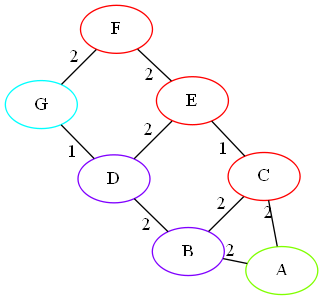
Your goal is to write a program that takes in a list of edge-node relationships, and print a directed adjacency matrix for it. Our convention will follow that rows point to columns. Follow the examples for clarification of this convention.

read more...

Making music, part 3: Making noise

Last week we parsed some music. That post was in a bit of a hurry, so we had to leave off a fair few important pieces (like ties and slurs for one; chords for a rather bigger one). We’ll get to them soon, but for now we want to actually get something playing back.

read more...

Making music, part 2: Taking shape

It’s been a bit, but as you may have noticed life is a bit mad at the moment. But I’ve still made some progress.

When we left off last time, we’d finished the first step towards making some lovely music with Racket: tokenization. Now we want to take those songs and form them into something actually approaching music.

read more...

Making music, part 1: Reading ABC notation

It’s been a bit since I’ve had time to post1, but I’ve got an interesting new project that I’ve been working on. It’s a bit more complicated, ergo spread out over a few posts, but those tend to be the more interesting posts anyway, eh?

The basic idea is that I want to be able to write and play music in Racket. One end goal would be to make a library available for the C211 class to give them something else to work with (in addition to <a href="//blog.jverkamp.com"/wombat-ide/c211-image-api/">images and <a href="//blog.jverkamp.com"/wombat-ide/c211-turtle-api/">turtles). To that end, here’s my current plan of attack2:

  • Write a lexer for ABC notation to turn raw text into a list of tokens
  • Write a parser to turn those tokens into a song (for example dealing with the interactions between key signature/accidentals and meter/note duration)
  • Use the rsound library on Planet2 / pkg to play back individuals notes and chords
  • Tie it all together to play a parsed song in ABC notation using the rsound library
  • (maybe): Use the rsound library to save ABC files as WAV audio
  • (maybe): Figure out the format and save ABC files as MIDI
  • (maybe): Render songs as music sheets/li>

Sounds like fun! Let’s get started.

read more...

Functions as lists

Yesterday’s challenge from Programming Praxis challenges us to rebuild a data structure near and dear to any Lisper’s/Schemer’s/Racketer’s1/functional programmer’s heart: lists. The idea presented in their sample solution uses two element vectors, directly mimicking the general internal structure of Scheme’s lists. How about we do something a bit stranger? 😄

read more...


All posts