Earlier this week, we started parsing, getting through groups, nodes, params, and lists. A pretty good start, but it also leaves out two very powerful things (expressions and defines), one of which we absolutely do need to start actually evaluating things: expressions. Since we use them in every param, we pretty much need to know how to parse them, so let’s do it!
JP's Blog
Programming, Language: Javascript
Recent posts (Page 8 of 11)
Runelang: The Parser (Part 1)
I’m still here! And less sick now.
Last time(s), we described and lexed) Runelang! This time around, let’s take the lexed tokens and go one step further and parse them!
So, how do we go about this? With a recursive descent parser!
- Start with a list/stream of tokens
- Using the first k (in a LL(k) parser) elements of the list, identify which sort of object we are parsing (a
group/identifier/literal/expression/ etc) - Call a parsing function for that object type (
parseGroupetc) that will:- Recursively parse the given object type (this may in turn call more parse functions)
- Advance the token stream ‘consuming’ any tokens used in this group so the new ‘first’ element is the next object
Runelang: The Lexer
Let’s LEX!
So this is actually one of the easier parts of a programming language. In this case, we need to turn the raw text of a program into a sequence of tokens / lexemes that will be easier to parse. In this case, we want to:
- Remove all whitespace and comments
- Store the row and column with the token to make debugging easier
So let’s do it!
Runelang: Language Specification
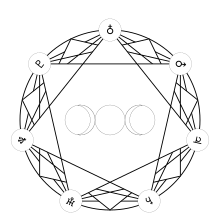
Previously, I wrote a post about making a DSL in Ruby that could render magic circles/runes. It worked pretty well. I could turn things like this:
rune do
    scale 0.9 do
        circle
        polygon 7
        star 14, 3
        star 7, 2
        children 7, scale: 1/8r, offset: 1 do |i|
            circle
            invert do
                text (0x2641 + i).chr Encoding::UTF_8
            end
        end
    end
    scale 0.15 do
        translate x: -2 do circle; moon 0.45 end
        circle
        translate x: 2 do circle; moon 0.55 end
    end
end
Into this:
But… I decided to completely rewrite it. Now it’s an entirely separate language:
Output
Source
Log (most recent messages first):
Neural Network Cellular Automata
Okay. A random post on the /r/cellular_automata subreddit inspired me.
Let’s generate a cellular automata where each pixel updates based on a neural network given as input:
- The x/y coordinates (scaled to the range 0-1)
- An optional random value (to make it more dynamic)
- A variety of neighboring data, such as:
- The number of neighbors that are ‘active’ (> 50% white), ranges 0-8 scaled to 0-1. This should allow Conway’s Game of Life
- The RGB values of all neighbors (allows a superset of the above)
- Gradients, subtract color value of the left from the right so that you get edges and side to side movement
Let’s do it!
Solving Snakebird
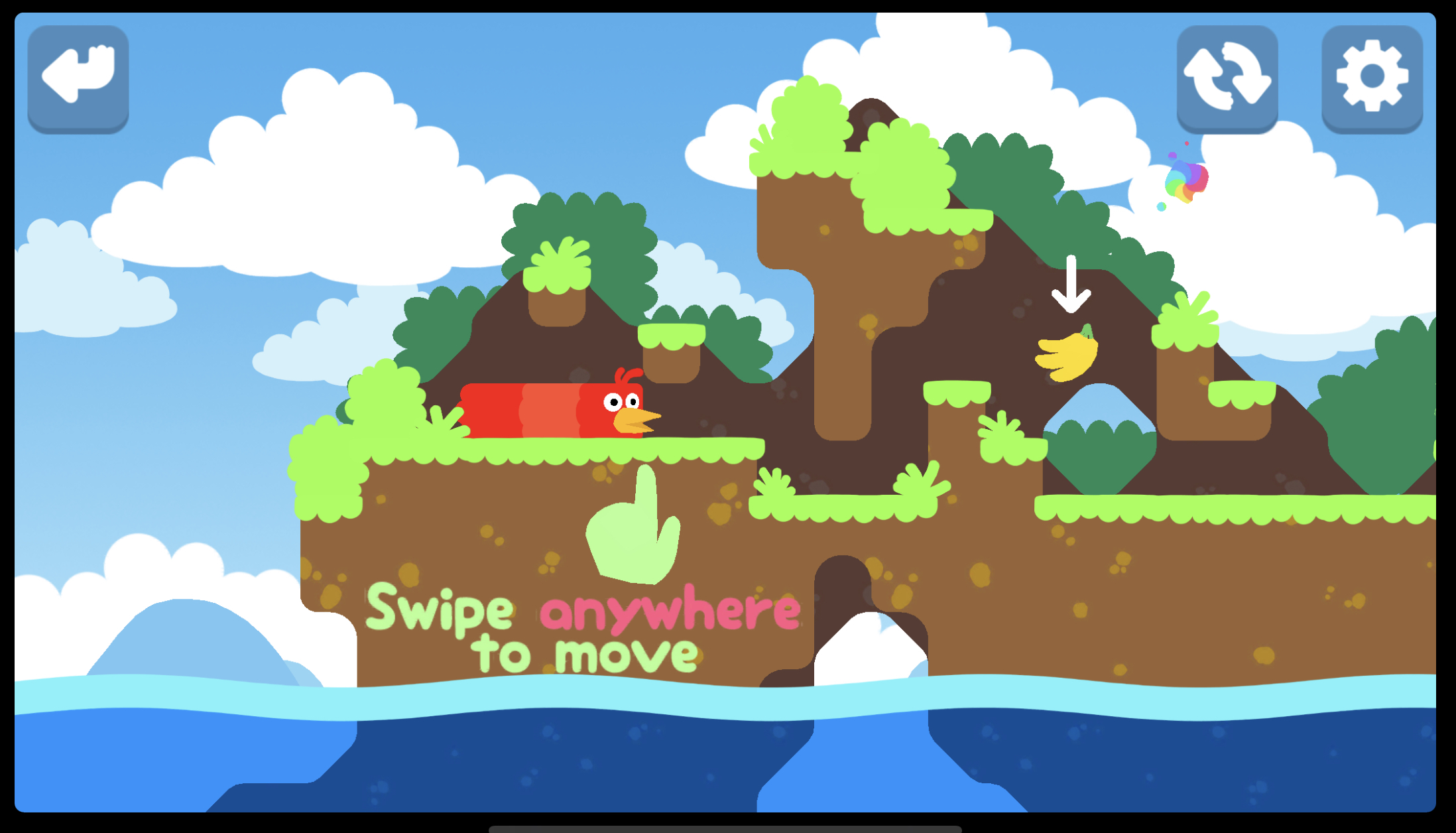
A cute little puzzle game, where you move around snake(birds). Move any number of snakes around the level, eating fruit, and getting to the exit. The main gotchas are that you have gravity to content with–your snake will easily fall off the edge of the world–and each time you eat a fruit, your snake gets bigger. This can help get longer to get into hard to reach places or it can cause trouble when you trap yourself in corners.
Let’s use the new immutable.js solver to solve these problems!
Immutable.js Solvers
A bit ago I wrote about writing a generic brute force solver (wow, was that really two months ago?). It got … complicate. Mostly, because every time I wrote a step function, I had to be careful to undo the same. Wouldn’t it be nice if we could just write a step function and get backtracking for ‘free’?
Well, with immutability you can!
A Generic Brute Force Backtracking Solver
One of the projects I’ve had vaguely in the back of my head is a sort of generic puzzle solver. I really love puzzles, but of the pencil and paper and video game varieties. So I think it would be awesome to write out a definition of a puzzle (say how to play Sudoku), give it input, and have it give me an answer back.
Well, I finally got around to trying it!
GMail Oldest First
It’s been rather a while since I last worked on a userscript, but there’s been a problem I’ve been trying to solve for some time.
I want to have my GMail in order from oldest to newest. While you can do this for all messages, you can’t do it within a single page.
Genuary: Triple Nested Loops
The fine people of /r/generative / Genuary2021 have a series of challenges for generative works for the month of January. I don’t think I’m going to do all of them, but pick and choose. For example, the very first prompt is:
// TRIPLE NESTED LOOP
My goal was to draw a grid of circles across the X/Y the image and nest them for the third dimension. To make it a little more interesting, I added a few different color modes. seededRandom is my personal favorite, that was interesting to get working.
All posts
- 2026-01-31: Genuary 2026: And so it ends
- 2026-01-31: Genuary 2026.31: Shader
- 2026-01-30: Genuary 2026.30: Bug
- 2026-01-29: Genuary 2026.29: Evolution
- 2026-01-28: Genuary 2026.28: No Libraries, No Canvas
- 2026-01-27: Genuary 2026.27: Lifeform
- 2026-01-26: Genuary 2026.26: Recursive Grids
- 2026-01-25: Genuary 2026.25: Organic Geometry
- 2026-01-24: Genuary 2026.24: Perfectionist's Nightmare
- 2026-01-23: Genuary 2026.23: Transparency
- 2026-01-22: Genuary 2026.22: Pen plotter ready
- 2026-01-21: Genuary 2026.21: Bauhaus poster
- 2026-01-20: Genuary 2026.20: One line
- 2026-01-19: Genuary 2026.19: 16x16
- 2026-01-18: Genuary 2026.18: Unexpected paths
- 2026-01-17: Genuary 2026.17: Wallpaper Groups
- 2026-01-16: Genuary 2026.16: Order vs Disorder
- 2026-01-15: Genuary 2026.15: Invisible Object
- 2026-01-14: Genuary 2026.14: Fits Perfectly
- 2026-01-13: Genuary 2026.13: Self Portrait
- 2026-01-12: Genuary 2026.12: Boxes
- 2026-01-11: Genuary 2026.11: Quine
- 2026-01-10: Genuary 2026.10: Polar coordinates
- 2026-01-09: Genuary 2026.09: Cellular automata
- 2026-01-08: Genuary 2026.08: A city
- 2026-01-07: Genuary 2026.07: Boolean algebra
- 2026-01-06: Genuary 2026.06: Lights on/off
- 2026-01-05: Genuary 2026.05: Write 'genuary'
- 2026-01-04: Genuary 2026.04: lowres
- 2026-01-03: Genuary 2026.03: Fibonacci forever
- 2026-01-02: Genuary 2026.02: Twelve principles of animation
- 2026-01-01: Genuary 2026.01: One color, one shape
- 2025-12-20: Locking BGA tabs with UserScripts
- 2025-05-29: Parsing PEM Certificates & ASN.1 in Javascript
- 2025-02-05: WebCrypto SHA-256 HMAC
- 2023-03-03: Genuary 2023.31: Break a previous image
- 2023-03-02: Genuary 2023.30: Minimalism
- 2023-03-01: Genuary 2023.29: Maximalism
- 2023-02-28: Genuary 2023.28: Generative poetry
- 2023-02-27: Genuary 2023.27: In the style of Hilma Af Klint
- 2023-02-26: Genuary 2023.26: My kid could have made that
- 2023-02-25: Genuary 2023.25: Yayoi Kusama
- 2023-02-24: Genuary 2023.24: Textile
- 2023-02-23: Genuary 2023.23: Moiré
- 2023-02-22: Genuary 2023.22: Shadows
- 2023-02-21: Genuary 2023.21: Persian Carpet
- 2023-02-20: Genuary 2023.20: Art Deco
- 2023-02-19: Genuary 2023.19: Black and white
- 2023-02-18: Genuary 2023.18: Definitely not a grid
- 2023-02-17: Genuary 2023.17: A grid inside a grid inside a grid
- 2023-02-16: Genuary 2023.16: Reflections of a Reflection
- 2023-02-15: Genuary 2023.15: Sine Waves
- 2023-02-14: Genuary 2023.14: Asemic Writing
- 2023-02-13: Genuary 2023.13: Something you've always wanted to learn
- 2023-02-12: Genuary 2023.12: Tessellation
- 2023-02-11: Genuary 2023.11: Suprematism
- 2023-02-10: Genuary 2023.10: Generative Music
- 2023-02-09: Genuary 2023.09: Plants
- 2023-02-08: Genuary 2023.08: Signed Distance Functions
- 2023-02-07: Genuary 2023.07: Sample a color palette
- 2023-02-06: Genuary 2023.06: Steal like an artist
- 2023-02-05: Genuary 2023.05: Debug view
- 2023-02-04: Genuary 2023.04: Intersections
- 2023-02-03: Genuary 2023.03: Glitch art
- 2023-02-02: Genuary 2023.02: Made in 10 minutes
- 2023-02-01: Genuary 2023.01: Perfect loop
- 2023-01-19: Local JS/CSS with Hugo Pipe
- 2022-08-29: Runelang: A Summoning Circle Generator
- 2022-08-25: Runelang: A Bind Rune Generator
- 2022-07-16: Runelang: Evaluation
- 2022-03-18: Runelang: The Parser (Part 2: Expressions)
- 2022-03-15: Runelang: The Parser (Part 1)
- 2022-02-24: Runelang: The Lexer
- 2022-02-23: Runelang: Language Specification
- 2021-09-06: Neural Network Cellular Automata
- 2021-08-18: Solving Snakebird
- 2021-08-17: Immutable.js Solvers
- 2021-06-25: A Generic Brute Force Backtracking Solver
- 2021-01-25: GMail Oldest First
- 2021-01-08: Genuary: Triple Nested Loops
- 2020-12-11: Pictogenesis: Stack Transpiling
- 2020-12-09: Pictogenesis: Stack Machine
- 2020-12-03: Pictogenesis: Transpiling
- 2020-12-01: Pictogenesis: Wrapping Modes
- 2020-11-24: Pictogenesis: Register Machine
- 2020-11-23: Pictogenesis: The Idea
- 2020-11-20: Backtracking Worm Coral
- 2020-11-19: Worm Coral
- 2020-11-18: p5js Boids
- 2020-11-17: p5js Worms
- 2019-05-02: Prevent JavaScript links by parsing URLs
- 2019-01-04: Listing and Downloading S3 Versions
- 2018-09-26: Simple LocalStorage Notepad
- 2016-01-02: Inlining plaintext attachments in Gmail
- 2014-08-24: Sandbox Battle!
- 2014-08-24: Ludum Dare 30: Demo mode
- 2014-08-23: Ludum Dare 30: Programmer art and simple AI
- 2014-08-23: Ludum Dare 30: 24 hours
- 2014-08-23: Ludum Dare 30: Hints of a game
- 2014-08-22: Ludum Dare 30: Sandbox Battle
- 2014-01-13: CSRF protection injection with jQuery and Zend
- 2013-03-18: Approximating Pi with Buffon's Needle
- 2013-03-06: Partitioning the Dutch national flag
- 2012-10-08: Evaluating prefix/infix/postfix expressions
- 2012-10-03: Elementary cellular automaton
- 2012-10-01: The Birthday Paradox
- 2012-09-27: HTML5 Bugs
- 2012-09-26: Line art with an HTML5 canvas
- 2012-09-20: Playing with loaded dice
- 2012-09-17: Who wants to win the lottery?