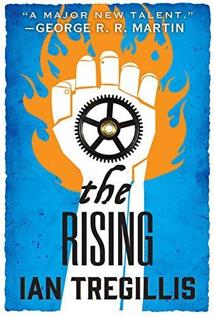
As had become his custom in recent mornings, Hugo Longchamp, captain of the guard of Marseilles-in-the-West, climbed the tallest tower in New France to await the end of the world. Doom had proved slow to arrive. The captain was getting impatient.
A rising war. And not just between the Dutch and the French…
Jax is on his own, fleeing free and northward. Berenice is on her own, causing chaos (both on purpose and inadvertently) behind enemy lines.
And Captain Longchamp is trying desperately to lead a defense against their implacable mechanical foes.
It’s a solid enough middle book, escalating the story of the first and leading us headlong towards the conclusion. What else could you ask for from a middle chapter?
One other thing I continue to enjoy about this series (on top of the worldbuilding) is the use of language.
An avalanche of French poured from the terrified man’s mouth only to pile at his feet, dusty and disregarded like so much unwanted talus. The language sounded to Jax as though the man wrapped each word in silk and tied it with a bow before letting it float past his lips. French was the language of the Catholics, who believed mechanical men were thinking beings capable of Free Will, and that their unswerving bondage indicated something evil, something unholy, had been done to their souls. It was the language of those who would see the end of Clakker slavery.
It was also the language of the doomed. And that saddened Jax.
It’s just… fun to read, which isn’t something you always get (or even need) in novels.
Onward, for one more!
Slightly spoiler side note, I did enjoy this digression on the Ship of Theseus writ mechanicals:
Neverland did not acknowledge the sanctity of a Clakker’s bodily identity. They treated themselves, and other mechanicals, as no more than the sum of their parts. Their meaningless, mass-produced, interchangeable parts.
Imagine that, Daniel, and then tell me. Is it still the same ship? Or is it no longer the same, but a different ship sailing under the same name?
Daniel mulled this. Mab’s mismatched eyes rotated in their sockets, bezels humming while she watched him.
Suppressing a rattle of revulsion, he said, I think your riddle rests on a deliberate ambiguity. To a landlubber who has never set foot on open water, a ship is merely a tangible physical object, a finite collection of wood and rope. But to the sailor who calls it her home, the ship is the sum of its voyages and of her adventures. Its spirit. But your question is posed in such a way as to juxtapose these meanings.
Yes, yes, you’re very clever. Just answer the damn question, Mab said.